
THE ROOFTOP BAR at Poseidon
(38 Shelter Cove Lane, #120 • Hilton Head Island, SC 29928)
Two seatings available 5:00–6:30pm & 7:00–8:30pm
Food Stations featuring specialty cuisine from all SERG Restaurants











PLUS Two Drink Tickets Included
(Beer & Wine)
•
Live Auction
Your Ticket is Your Donation
Proceeds from the Piper’s Path Forward event will help send Piper to the ACQUIRE program at Virginia Tech— one of the few that offers intensive, research-backed therapy while training parents to carry it over at home, making her progress more consistent and meaningful.

Can’t make it to the event?
Please donate to Piper’s GoFundMe

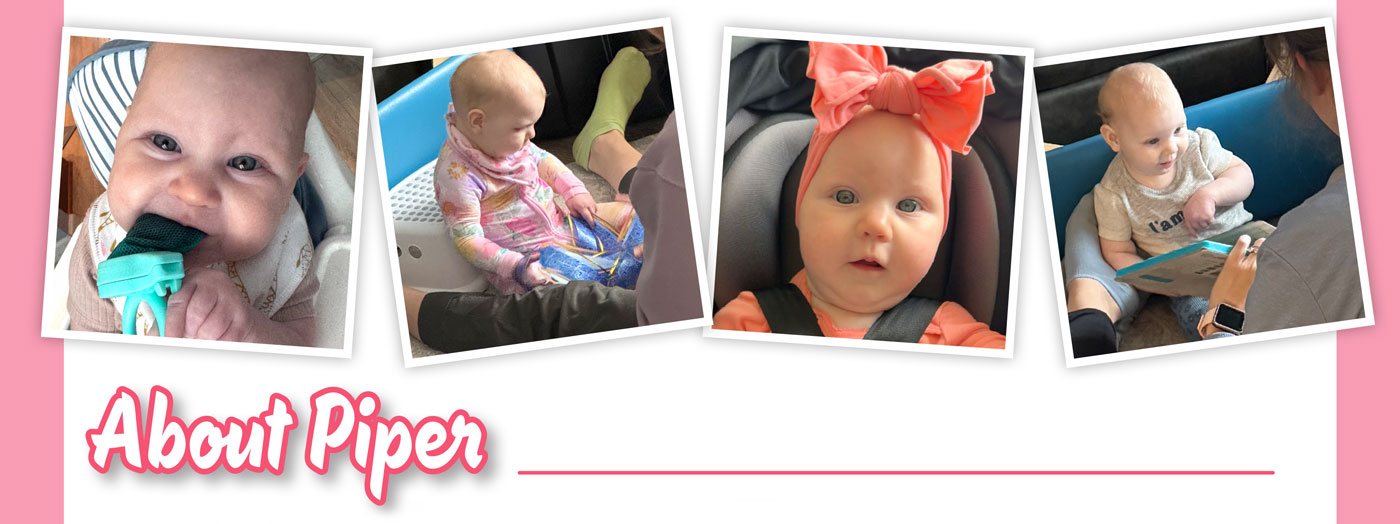
Piper, daughter of two longtime SERG team members, is a 19-month-old little girl diagnosed with CASK Disorder with MICPCH (Microcephaly with Pontine and Cerebellar Hypoplasia). Her diagnosis was confirmed after an extensive medical journey that included two EEGs, an MRI, and two rounds of genetic testing.
Piper’s pregnancy and birth were completely normal. She was born on time, did not require a NICU stay, and there were no immediate concerns at birth. Around 4½ weeks old, however, our family began to notice that something didn’t seem quite right developmentally. As time went on, Piper began missing milestones and showed signs of global developmental delays.
Piper currently experiences hypotonia (low muscle tone), microcephaly, major sleep difficulties, feeding difficulties, balance challenges, and both fine and gross motor delays. She is currently non-verbal, not yet walking, and is still working on fully independent sitting. Due to feeding difficulties and slow weight gain, Piper is G-tube dependent but also takes purées by mouth. She has been hospitalized twice and has undergone two surgeries: a laser release of lip, tongue, and cheek ties, and G-tube placement surgery.
Piper began Early Intervention around 8 months old and currently participates in physical therapy, occupational therapy, speech therapy, and feeding therapy. In March 2026, she attended an intensive therapy program at ACQUIRE Therapy, where she made some of her biggest developmental gains so far. Our family has seen major improvements in her head and trunk control, her ability to sit with assistance and for short periods independently, and her ability to interact with and play with toys.
Piper currently uses a Rifton Activity Chair and an R82 Chilla stroller for support, and she is scheduled to receive a Go Baby Go adaptive car, which will help her gain mobility and independence.
Despite the many challenges she faces, Piper is a very happy, giggly, and incredibly determined little girl. She loves Ms. Rachel, her brothers, music, books, being outside, and bath time. Her favorite toys are crinkly books, her Ms. Rachel doll, and anything that lights up. She especially loves being played with, talked to, tickled, and surprised, and she rewards everyone around her with the best giggles.
When Piper’s doctors first began testing, our family was told they did not know what was causing her delays and that genetic testing would hopefully provide answers. We were also told that they were unsure whether Piper would ever walk, talk, or be independent. While Piper may not yet be where most children her age are developmentally, she continues to make meaningful progress and is working hard to gain the skills she needs in her own time.
Our family’s hopes for Piper’s future are that she continues to gain independence in whatever ways possible — whether that means eating by mouth, sitting independently to play, crawling, or communicating. But more than anything, our greatest hope is that Piper always knows how deeply she is loved, supported, and believed in, and that with the right support and opportunities, she can continue to grow, learn, and reach her fullest potential.
CASK disease is a rare genetic disorder caused by a mutation in the CASK gene, which is important for proper brain development and function. This condition falls under a group of neurological disorders that can affect motor skills, speech, vision, and overall development. Children with CASK disease often experience developmental delays, low muscle tone, difficulty with coordination and balance, and may also have seizures. In many cases, the condition is diagnosed in infancy or early childhood as developmental milestones are delayed. The severity can range, but it typically requires ongoing medical care, therapy, and support. Although there is currently no cure, early intervention and specialized therapies can help children reach their fullest potential and improve day-to-day quality of life.